
What is Kashima, and where is it in Japan? First, let’s start with a mini geography lesson.
In Canada, we have 10 provinces and 3 territories, yet Japan has 47 prefectures. However, the latter is significantly smaller in terms of land mass. It is ~4,200km from Vancouver to Toronto, and in Japan, it’s only 500km between Tokyo and Osaka (basically like Toronto to Montreal).
You might notice people refer to the Kanto and Kansai regions. These are similar to how we group the Atlantic provinces, prairies, etc, in Canada. In Japan, the groupings are as follows:
- Honshu (main island, comparable to saying “mainland Canada”)
- 8 Regions (Kanto, Kansai, Hokkaido, Tohoku, Chubu, Chugoku, Shikoku, and Kyushu)
Tokyo is a prefecture in the Kanto region. Tokyo is unique as it’s both a prefecture and metropolis with 23 wards (municipalities) within Tokyo-to (the -to 都 is added at the end to refer to the metropolis). The main 5 central wards are Chiyoda-ku, Chuo-ku, Minato-ku, Shinjuku-ku, and Shibuya-ku (the -ku 区 is like saying city). A post on Tokyo touching on these five wards and a few others will be coming soon.
In Japanese, prefectures aren’t directly referred to as a prefecture; in fact, they’ll use either Ken 県, Do 道, Fu 府, or To 都 (like in Tokyo’s case). The majority use Ken (43), then Do is for Hokkaido, Fu for Kyoto and Osaka (because of historical reasons), and To for Tokyo.
Japanese Addresses
Ok, that’s a lot, but why do you need to know this? Japanese addresses. They are different. In simple terms, the address starts big and gets smaller. When writing an address, you start with the postal code (opposite of Canada, where we normally put the code at the bottom), and then you would indicate the prefecture, city/ward, town/district, block, building number, and finally the apartment/room number and recipient’s name.


Notice something odd? Yeah, there aren’t any street names. You’ll usually see three numbers in the following format: 3-2-1, which signifies District 3, Block 2, Building 1. Because Japanese people use Arabic numerals for addresses, this will save you a lot of time when locating where you are on a map, where you are looking to go, and what information you need when trying to locate anything where the address is primarily written in kanji.

If I were to enter the example address into Google, I would type 174-0076 into Google to find the postal code on the map.

Sometimes the postal code is small enough that you can figure things out fast, but if not, your next step is to look for the first number in that three (sometimes only two) number series. This is the Chome 丁目 (district). The screenshot shows 1 Chome (1丁目). If I zoom in and look to the left, I can find 2 Chome.

If I click on the 2 Chome, I get another border region.

Zoom in and look for the second number (the block).

To the right of block 34 and below 36 is block 35. You can see the 7-Eleven clearly on the map.
In summary, use the numbers in Japanese addresses and practice zooming in on Google Maps to locate the blocks and the districts.
Now, to answer the original question: What is Kashima, and where is it in Japan?
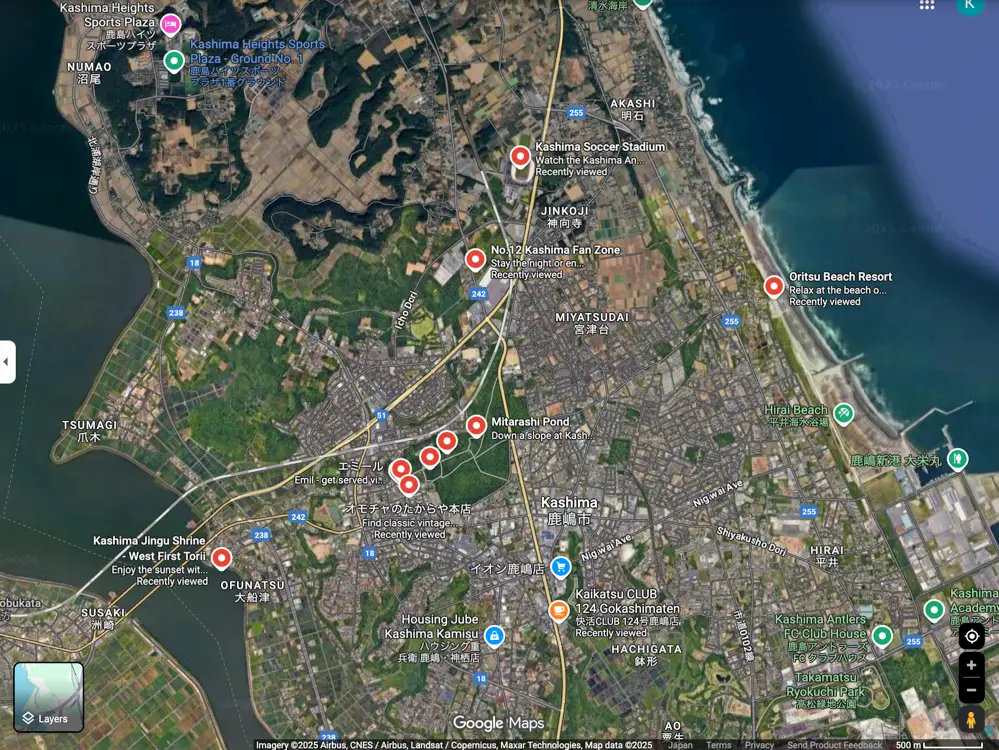
Kashima City 鹿嶋市 (Kashima-shi) is a municipality located in Ibaraki Prefecture 茨城県 (Ibaraki-ken) and is ~100 km northeast of Tokyo-to (about 2 hours by train/car). Kashima is like a mid-sized Canadian city. In comparison, it would be like Moncton, NB. A city, but not a major urban center. Ibaraki is located in the Kanto region in the GTA—the greater Tokyo area. Kashima is relatively small, spanning just 10km east-to-west.

What is there to do in Kashima?
While the main reason you’ll be here is for the wedding ceremony, Kashima has some unique spots worth visiting if you have extra time. For accommodation, we actually recommend staying in a nearby city for convenience (or closer to Narita Airport). That said, I’ve saved a few highlights in the linked Google Maps list—here’s a guide to what you can see and do in Kashima, most of which is located around Kashima Jingu Shrine, the wedding venue.

Kashima Jingu is one of Japan’s oldest and most significant Shinto shrines, dedicated to Takemikazuchi-no-Ōkami, the god of martial arts. While visiting, you can:
- Explore the expansive shrine grounds.
- Collect a goshuin (shrine stamp) as a keepsake.
- Pray for future success.
- Admire the rebuilt torii gate at the entrance (the original was destroyed during the 2011 Tōhoku earthquake).
The shrine is at the center of Kashima and will also be the location of our wedding ceremony.

Within the shrine grounds you’ll find sacred Sika deer, revered as divine messengers. While you can feed them, you can’t pet them (they are still wild animals).
The deer here have deep ties to Japanese legend. It is said that the god Takemikazuchi, protector of Kashima, traveled to Nara riding on the back of a white deer. This connection is why Nara’s famous park deer are believed to have originated from Kashima Jingu.

Just down a slope within the shrine grounds is Mitarashi Pond, a beautiful spot featuring a torii gate set over crystal-clear spring water, with sacred koi fish swimming below.
Traditionally, worshippers purified their bodies and souls here before approaching the shrine. These days, purification is more symbolic, done at designated washing stations for hands and mouth.
Fun fact: A video of this pond was what first drew us to choose Kashima Jingu as our wedding location.

This small shopping street leads right up to Kashima Jingu. It’s a charming place to wander and grab a bite or drink. Highlights include:
エミール Emil Café – a Japanese-style café where dishes are delivered to your table by miniature train! The first floor is a traditional café, while the second floor is the train-themed one. Expect classics like spaghetti, melon soda, and ice cream sundaes.
Paradise Beer Factory – a craft brewery and restaurant serving freshly brewed beer and wood-fired pizza, just a short walk from the shrine.
You can also have a bite to eat at one of the soba noodle restaurants.

A nostalgic stop near the shrine, Takara-ya is a vintage toy shop filled with model kits, collectibles, and toys. Of note are shelves of Tomica cars—Japan’s beloved die-cast toy vehicles made by Takara Tomy (the store’s name reflects that connection). Even if you’re not toy shopping, it’s a fun place to browse.

Located a short distance from the main shrine, this massive torii gate stands in the waters of the Wani River. It’s known as the “first” torii of Kashima Jingu, marking the traditional entrance to the sacred grounds. Unlike more famous “floating torii” spots in Japan (like Miyajima in Hiroshima), this one is far less crowded, offering a peaceful photo opportunity.

Kashima is a port city on the Pacific Ocean, and Oritsu Beach is a nice spot to relax, watch surfers, or enjoy the sea breeze. If you’re visiting in May, you can join in shiohigari (潮干狩り)—clam digging!
Rental shops at Japanese beaches often provide buckets, rakes, net bags, sandals, and hats for a reasonable price.
If you have larger feet (men’s size 9+ / women’s size 8+), it’s a good idea to bring your own water shoes from abroad, as Japanese rentals sometimes only go up to 8/9 (~28cm).

Kashima’s coastal location makes it great for fishing. Most saltwater fishing spots in Japan don’t require a license, so it’s easy to try. For bait and gear, stop by Kakurai fishing shop, where there’s even a vending machine that sells live bait.

Soccer fans will know Kashima as the home of the Kashima Antlers, one of Japan’s top J.League teams. If the schedule lines up, you can catch a match at Kashima Soccer Stadium (Mercari Stadium), which is located near Kashima Jingu.

Located within walking distance of both the shrine and the stadium, this guesthouse and public sauna is a unique experience. On Antlers match days, it transforms into a fan hub.
The sauna is mixed-gender (swimsuits required).
One highlight is a repurposed American school bus turned into a sauna.
Guests can stay overnight or just enjoy the facilities for a day visit.
Leave a Reply